
In 2025, MBARI embarked on a bold new chapter in our work as we welcomed a new flagship research vessel, R/V David Packard, to our fleet. Named for MBARI’s founder, the late Silicon Valley innovator and ocean philanthropist David Packard, this state-of-the-art ship will enhance MBARI’s capacity to pursue bold marine research initiatives and transform ocean science and engineering.
More than a decade in the making, R/V David Packard was designed by Glosten—in partnership with MBARI’s marine operations team—and constructed by the Spanish ship-building company Freire Shipyard. After arriving at our headquarters in Moss Landing, California, in March 2025, MBARI’s marine operations team began integrating the complicated and custom systems needed for ocean science aboard the David Packard and logged four successful expeditions with our new flagship vessel.
MBARI is a hub of innovation, where scientists and engineers work together to push the envelope in ocean science and technology. R/V David Packard exemplifies our founder’s commitment to innovation, providing a platform for our researchers to make new discoveries about marine ecosystems and advance much-needed efforts to monitor ocean health.
Expanded capacity for ocean exploration
Believing that science and technology are critical to understanding and protecting the ocean, MBARI designed R/V David Packard to maximize the potential for on-the-water scientific discovery.
At 50 meters (164 feet) long and 12.8 meters (42 feet) wide, our new ship can accommodate up to 30 crew members and researchers for voyages lasting up to 10 days offshore of California, as well as extended expeditions across the Northeastern Pacific Ocean. By comparison, the ship is 62 percent larger by volume than our previous flagship research vessel, R/V Western Flyer.
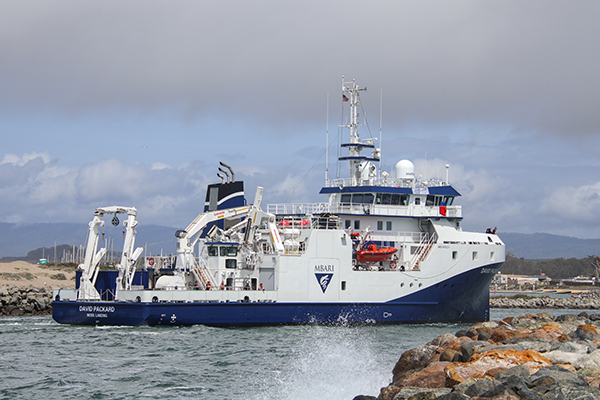
The larger size will expand MBARI’s ability to study how climate change and other threats are affecting marine life and environments across the West Coast, from the Pacific Northwest to Baja California, and beyond. The ship can go to locations we have never been before, leveraging what we have learned in Monterey Bay to explore new and exciting destinations. A bigger ship will also increase our ability to collaborate with colleagues by allowing MBARI scientists to invite external partners aboard to share expertise and work together to advance ocean research.
The ship serves as the command center for MBARI’s remotely operated vehicle (ROV) Doc Ricketts, a robotic submersible that can dive up to 4,000 meters (2.5 miles) underwater. MBARI researchers rely on this technology to study marine life, ecosystems, and processes deep beneath the ocean’s surface.
Unlike its predecessor, R/V David Packard can also support the launch and recovery of MBARI’s autonomous technologies, including underwater vehicles that can map the seafloor, conduct visual surveys of the midwater, and monitor ocean health, as well as aerial drones that can document sea surface conditions and wildlife.
The David Packard joins R/V Rachel Carson and R/V Paragon in MBARI’s fleet of research vessels. R/V Rachel Carson will continue to serve as the primary platform for MBARI’s coastal operations, including support for the ROV Ventana and the launch and recovery of autonomous underwater vehicles, moorings, and many other surface and underwater instrument packages. R/V Paragon will continue to support nearshore scientific scuba diving and the launch and recovery of a variety of smaller autonomous technologies.

MBARI’s expedition to Oregon allowed the crew of R/V David Packard to test and refine operations for future mapping missions. Image: Dave Caress © 2025 MBARI
A new tool for seafloor mapping
R/V David Packard is the first vessel in MBARI’s fleet equipped with a multibeam echosounder, allowing our researchers to map a wide swath of seafloor. MBARI scientists can use this technology to chart entirely new areas, identify features of interest, conduct repeat surveys to assess seafloor dynamics, and precisely target deployments of autonomous underwater vehicles (AUVs) and MBARI’s ROV Doc Ricketts.
In July 2025, MBARI’s Seafloor Mapping Lab, working closely with R/V David Packard crew, conducted a 17-day expedition to put this cutting-edge system through its first real-world tests, mapping Oregon’s Rogue Canyon system. Located in the Cascadia Subduction Zone, this underwater canyon holds vital clues for predicting future earthquakes and tsunamis in this seismically active area of the Pacific Northwest.

Using the Benchtop ESP (right) and a nanopore sequencer (left), MBARI researchers conducted DNA sequencing while at sea aboard our new flagship vessel, R/V David Packard. Image: Joe Warren © 2025 MBARI
The team mapped the entirety of the Rogue Canyon system at a higher resolution than ever before, from the canyon’s head at depths around 100 meters (328 feet) and down its winding path, where it meets the abyssal hills of the Gorda Ridge 3,500 meters (11,483 feet) deep.
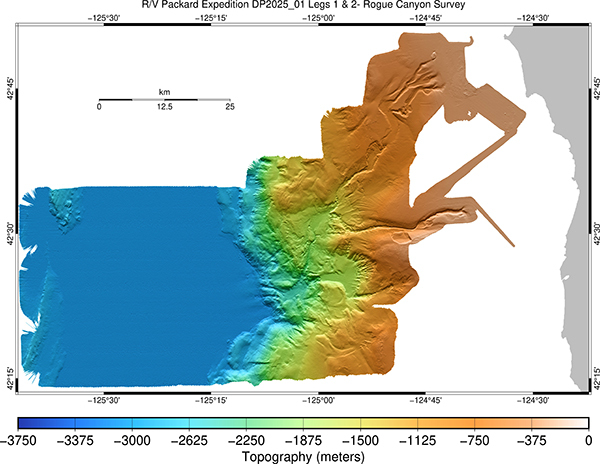
The new data we collected reveal details about how sediments from turbidity currents—underwater landslides often triggered by earthquakes—are transported through the complex channel system and deposited at the base of the continental slope. This information will help our collaborators and peers identify precise locations to collect sediment cores on future expeditions and reconstruct the region’s seismic history.
The mission marked a major milestone for the David Packard, proving its advanced capabilities and opening the door for MBARI scientists to explore previously uncharted parts of the ocean—including places critical to understanding and mitigating seismic hazards along the U.S. West Coast.
Demonstrating our commitment to open science, MBARI will make the fully processed Rogue Canyon survey data publicly available through the Marine Geoscience Data System (MGDS) and NOAA’s National Centers for Environmental Information (NCEI), ensuring that researchers worldwide can benefit from these detailed maps.
The expedition also created opportunities for scientific exchange. MBARI hosted collaborators from Oregon State University who will operate similar mapping technology on the university’s forthcoming R/V Taani.
Observing the ocean in new dimensions
MBARI designed the David Packard to serve as a powerful new platform for ocean exploration, science, and engineering. New systems aboard the ship bring the lab to sea, allowing scientists to deploy a diverse array of tools to answer big and bold questions about marine life, ecosystems, and processes.
In September 2025, R/V David Packard served as the headquarters for MBARI’s Biological Oceanography Group for an expedition to describe the abundance and distribution of marine animals during the daily migration between the surface and the deep sea.
At sunset, billions of animals travel from the deep sea to surface waters to feed, then retreat to the ocean depths at dawn. This daily event provides a vital link between the surface and the deep sea, yet many fundamental questions remain about vertical migration.
Marine organisms leave behind a trail of shed cells, skin, waste, and mucus as they move around in the ocean. Known as environmental DNA (eDNA), this mix of genetic material is transforming our ability to study marine life. Just a few drops of water contain the DNA “fingerprints” to identify marine organisms.

The David Packard is equipped with a variety of tools for oceanographic research, including a CTD rosette that collects water samples at specific intervals to profile ocean conditions from the surface to the depths below. Image: Katie Pitz © 2025 MBARI
MBARI’s Environmental Sample Processor (ESP) can collect and preserve eDNA as well as detect harmful organisms and toxins. Thanks to more than two decades of engineering innovation from MBARI’s SURF Center, this technology is small enough to be installed inside an autonomous underwater vehicle or used on a lab bench.
ESP technology also enabled MBARI’s first high-accuracy genetic sequencing at sea aboard the David Packard.
Spring-loaded bottles on a CTD rosette collect water samples at specific depths that researchers can process after the instrument is retrieved to look for the genetic fingerprints of migrating animals. The new higher-capacity CTD rosette on R/V David Packard allowed the Biological Oceanography Group to collect samples at much higher resolution across the water column to look for the DNA signatures of marine animals.
After processing water samples with the Benchtop ESP to isolate eDNA material, researchers used a nanopore DNA sequencer to identify specific genetic markers and build a real-time catalog of marine life while at sea, providing a context for observations logged by autonomous technologies deployed in the field at the same time.
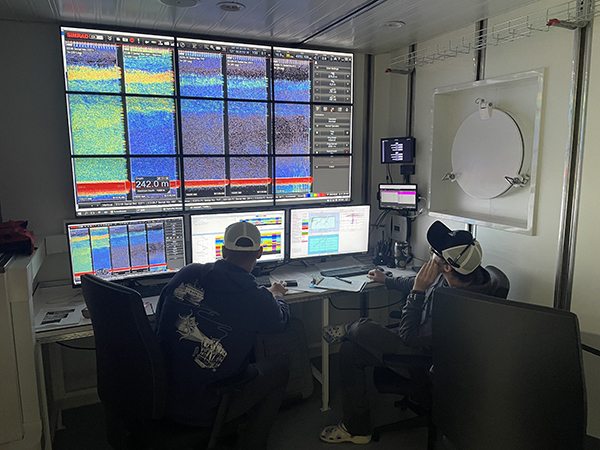
Sound offers another lens to “see” migrating organisms. Using acoustic echosounder technology on R/V David Packard, the expedition team was able to observe the migration of organisms from the depths every evening and contextualize their eDNA samples. By pairing acoustic and DNA data, they hope to quantify and see species-specific patterns of migration that have been difficult to detect in the past.
The advanced oceanographic tools aboard the David Packard allowed MBARI researchers to collect data at much higher resolution than before. In October, MBARI’s Chemical Sensors Team embarked on an expedition to Southern California to study nutrient cycling in the oxygen-poor waters of the Santa Barbara and Santa Monica Basins.
Some regions of the ocean have very little oxygen and support microbial communities that consume large amounts of nitrogen and sulfur. These oxygen-deficient zones (ODZs) play an outsized role in global biogeochemical cycles, but have been challenging to study.
MBARI researchers from the Global Ocean Biogeochemistry Array project have identified an innovative solution to this problem that leverages statistics to unlock new capabilities in the sensors on robotic floats to detect the intermediate compounds produced by microbes in ODZs.
The expedition aboard the David Packard provided the opportunity to compare real-world results with statistical predictions to ground-truth this new method for monitoring critical nutrients like nitrite and thiosulfate.
The ability to track nitrite and thiosulfate alongside oxygen, pH, and bio-optics opens new doors for studying the microbial processes driving global biogeochemical cycles at scales previously impossible. Autonomous robotic floats can gather high-resolution data about ODZs not only across larger areas but also for longer periods of time and move from sporadic shipboard snapshots into continuous time-series data.
This work underscores how MBARI’s advanced research platforms, the expertise of our team, and our international collaborations work together to advance our ability to monitor ocean health and reveal hidden, but important, processes across the global ocean.
A new chapter for ROV Doc Ricketts
ROV Doc Ricketts has been a vital tool for MBARI’s research, helping us better understand the midnight zone and abyssal seafloor.
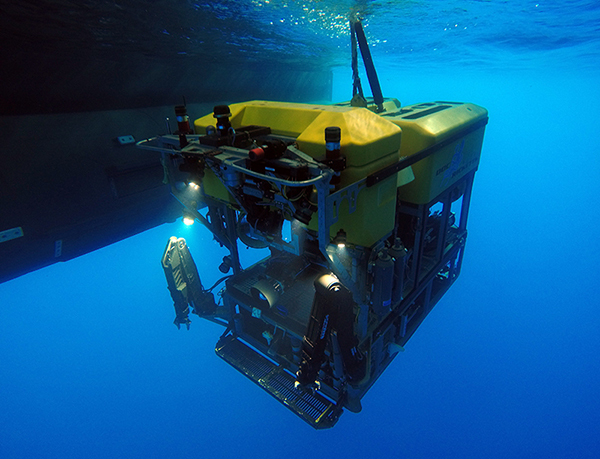
This larger, deeper-diving vehicle enables extended observations of animals and environments up to 4,000 meters (2.5 miles) underwater. Previously in service on our former flagship, R/V Western Flyer, this remotely operated vehicle has allowed researchers to describe remarkable new species, including the harp sponge (Chondrocladia lyra), mystery mollusc (Bathydevius caudactylus), and bumpy snailfish (Careproctus colliculi). Doc Ricketts is also a platform for engineering innovation that our researchers have leveraged to map vibrant communities of deep-sea corals and sponges at Sur Ridge and monitor nesting pearl octopus (Muusoctopus robustus) at the famous Octopus Garden.
After sea trials in early November and early December to test launch and recovery procedures and the ROV video recording process, MBARI completed integration of ROV Doc Ricketts with the David Packard.
MBARI’s first ROV science mission on R/V David Packard was a collaboration with our education and conservation partner, the Monterey Bay Aquarium. This three-day expedition to collect animals for the Aquarium’s Into the Deep / En lo Profundo exhibition afforded an opportunity to further refine ROV operations, including use of the vehicle’s manipulator arms and other advanced sampling systems.
MBARI and the Monterey Bay Aquarium have a rich history of collaboration. We work closely together to introduce Aquarium visitors to the wonders of the deep sea and inspire stewardship of the largest living space on Earth. Into the Deep / En lo Profundo represents the most extensive collaboration between our two organizations. This groundbreaking exhibition opened in April 2022, showcasing rarely seen deep-sea animals and highlighting MBARI staff, research, and technology.
Aquarium biologists were able to take advantage of the expanded capabilities of the David Packard to explore waters farther offshore at Sur Ridge, a deep-sea coral garden teeming with life. The longer dives—up to 12 hours underwater—allowed the team to collect more animals, critical for a new Aquarium research project aiming to better understand the diet and growth of deep-sea comb jellies. The expedition also provided an opportunity to deploy an “elevator” developed by MBARI engineers that allows Aquarium biologists to safely stow deep-sea animals for transport to the surface.
The hard work of the dedicated crew, pilots, and engineers in our marine operations team sets the stage for even more ambitious expeditions with the David Packard in 2026. As we make new discoveries at sea, we will share data with the field, creating new partnership opportunities. We look forward to sharing MBARI research, technology, and data with our peers and resource managers, and policymakers who are making decisions about the future of the ocean.
“The David Packard is an exciting addition to MBARI’s fleet. It’s an essential tool for exploration that offers an opportunity for collaboration with the wider ocean science and technology community.” —Director of Marine Operations Kaya Johnson