
2025 brought significant strides in MBARI’s development along our Strategic Roadmap, which will span the decade from 2023 to 2033. Our new flagship, research vessel David Packard, arrived in Moss Landing in March, and we celebrated the ship’s commemoration with our staff and Board of Directors in June. Another milestone was the completion of the new Instrumentation Integration and Testing Facility, which will provide MBARI researchers with space and tools to develop new scientific instruments for studying ocean health and monitoring the impacts of human actions on marine life and ecosystems.
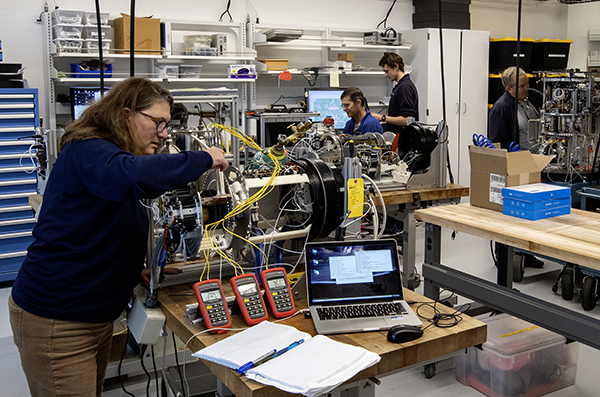
Now that we’ve moved into this new facility, our team is taking full advantage of all the building has to offer. From interactive areas with stunning views of Monterey Bay to meeting spaces to a multimedia center that can host in-house training programs, workshops, and seminars, the new building supports MBARI’s strategic goals. The building will also serve as the headquarters for two research collaboratives hosted by MBARI—the Central and Northern California Ocean Observing System (CeNCOOS) and Synchro. And we’ve made major updates to our pier to better accommodate our fleet and increase safety in the port. Arriving just as these upgrades to MBARI’s core infrastructure were coming to life has made my initial months and the intensive onboarding process since my arrival in late April very exciting.
The arrival of R/V David Packard on March 31 from Vigo, Spain, was a historic event, marking the start of preparations for the diverse array of missions it was built to support. MBARI engineers and marine operations crew have spent much of the year adapting, testing, and fine-tuning systems to meet the institute’s unique needs. With successful sea trials and the vessel’s first science missions, we’ve begun to lay the foundation for this state-of-the-art ship to expand MBARI’s geographic reach and strengthen our research, engineering development, and outreach capacity.
The complex process of preparing R/V David Packard has been a team effort, involving staff from across the institute to support our marine operations team’s work. The ship’s arrival involved significant time spent developing a new crewing plan, assessing operational costs, and implementing the technical and procedural innovations required by this new ship. Integration of the remotely operated vehicle (ROV) Doc Ricketts brought substantial upgrades, including new pilot/user interfaces and a spectacular range of sensors, cameras, and digital technologies that connect the ROV control room—and our enthusiastic scientists, engineers, and operations team—to the deep sea.
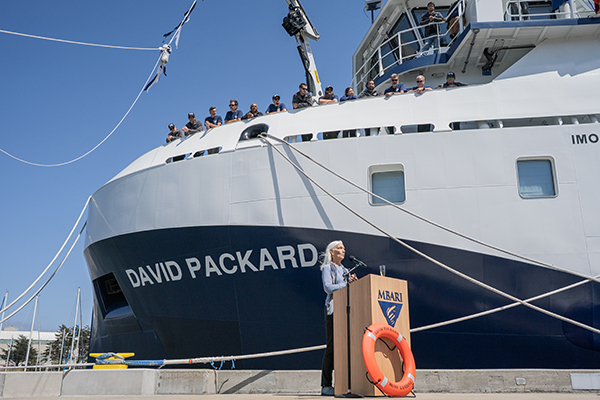
June 4, 2025. Image: Mauro Candeloro © 2025 MBARI
The first science mission of 2025 included seafloor mapping to advance earthquake and tsunami research, resulting in a new high-resolution map of the Oregon seafloor. The ship’s new state-of-the-art multibeam echosounder can visualize the deep seafloor in remarkable detail. Closer to home, the 2025 CANON project used MBARI’s advanced technology, including R/V David Packard, to collect detailed data about marine life, ecosystems, and processes. The research vessel also provided MBARI chemists with the opportunity to compare real-world results with statistical predictions to ground-truth their new method for monitoring critical nutrients, such as nitrite and thiosulfate. This work underscores how MBARI’s advanced research platforms, our team's expertise, and our international collaborations work together to enhance our ability to monitor ocean health and reveal hidden yet important processes across the global ocean.
Just as we were ending our first year of operations for the new flagship, after months of work integrating complex, custom systems to operate the ROV Doc Ricketts, we completed the first science dives with our education and conservation partner, the Monterey Bay Aquarium. The three-day expedition to collect animals for the Aquarium’s Into the Deep / En lo Profundo exhibition afforded an opportunity to further refine ROV operations, including use of the vehicle’s manipulator arms and other advanced sampling systems.
Our team added numerous other new technologies to MBARI’s ocean science toolbelt. These new tools substantially increase our global reach and contribute to MBARI’s long-term strategic goal to implement scalable robotics—from singular high-tech solutions to smaller, more mobile, and accessible tools. The MOLA AUV, MiniROV, and Geo-Sense all support MBARI’s capabilities to continuously monitor chemical, geological, and biological ocean change in real time. Technology developed and deployed by our teams, like EyeRIS and SINKER, provides new insights into life in our changing ocean.
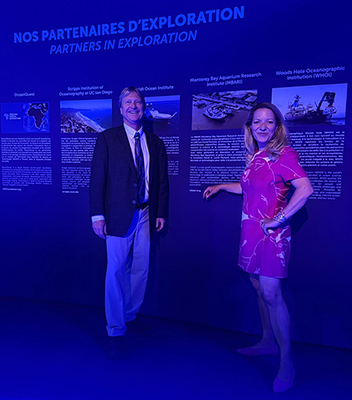
Collaboration is key to MBARI’s work, within the institute and around the world. As a leader in ocean science and engineering, MBARI continues to engage in international efforts to understand our changing ocean and to share data and findings with our peers and decision-makers.
In June of 2025, I participated in the United Nations Ocean Conference (UNOC) in Nice, France, joining Outgoing President and CEO Chris Scholin, Board of Directors Chair Julie Packard, and a delegation from the Monterey Bay Aquarium to highlight the institute’s work on a global stage to facilitate new international collaborations. With the OceanX team, we introduced conference delegates and visitors to the extraordinary animals and environments that thrive in the deep sea with the Deep Blue Pavilion. At UNOC, I had the honor of opening the conference alongside artists from around the world, and I participated in the launch of the UN Decade of Action for the Cryosphere Science 2025–2034. Later in the year, I was also pleased to participate in Climate Week NYC, celebrating the beginning of the international Neptune Mission and ratification of the High Seas Treaty.
MBARI’s global reach continued as teams across the institute conducted research from the Arctic to Antarctica and the Galapagos to Ghana, just to name a few. The map on the inside cover of this report shows the extent of MBARI’s global research in 2025. We are committed to continuing our work—from Monterey Bay to the global ocean.
I would like to thank our Board, MBARI staff, and our neighbors around the Monterey Bay for all their support during this exciting onboarding phase. For me, it is a dream come true to be part of the MBARI team in this new chapter. Advancing marine science and technology to understand our changing ocean is a critical contribution to our future. And knowing more about the life around us is also a great source of joy and hope. Enjoy our 2025 Annual Report!
