
Collaboration is at the heart of everything we do at MBARI, both across disciplines and with partners worldwide. We believe scientists and engineers working side by side enable technological innovation that can transform our understanding of the ocean and enhance our ability to address the urgent threats it faces. That spirit of collaboration extends beyond our walls too.
To maximize the impact of science and technology in service of ocean discovery, MBARI shares our science, technologies, and data with our peers to help strengthen the global ocean research community. Together, we can leverage each other’s strengths to advance marine science and engineering to understand our changing ocean.
“With the ocean facing a critical crossroads, collaboration is essential to safeguarding the future of marine life, ecosystems, and resources.”
—President and CEO Antje Boetius
Informing policy and conservation
The ocean plays an integral role in global economies, providing jobs in diverse sectors. With the ocean at a critical crossroads, MBARI research and technology are positioned to guide policy and responsible stewardship of marine life, ecosystems, and resources.
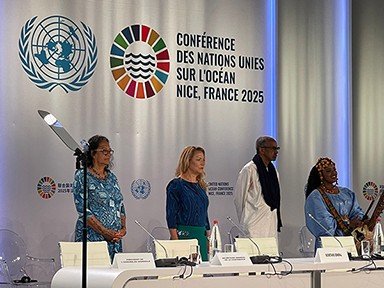
Last summer, MBARI President and CEO Antje Boetius joined Outgoing President and CEO Chris Scholin, Board of Directors Chair Julie Packard, and a delegation from the Monterey Bay Aquarium at the United Nations Ocean Conference (UNOC). The week-long conference in Nice, France, opened on World Ocean Day, bringing together stakeholders from around the world to accelerate action and mobilize all actors to conserve and sustainably use the ocean. Representatives from governments, intergovernmental organizations, financial institutions, NGOs, civil society organizations, academic institutions, the scientific community, the private sector, philanthropic organizations, Indigenous peoples, and local communities gathered to assess challenges and opportunities facing the ocean.
The delegation highlighted our two institutions’ work on a global stage and facilitated new international collaborations. Boetius had the honor of opening the conference alongside artists from around the world and participated in the launch of the UN Decade of Action for the Cryosphere Science 2025–2034. With our peers from OceanX, we also introduced conference delegates and visitors to the extraordinary animals and environments that thrive in the deep sea.
In September, Boetius participated in Climate Week NYC to share how international scientific collaborations can help guide policy to address climate change, especially in vulnerable polar environments.

During a roundtable organized by the Prince Albert II of Monaco Foundation, Boetius connected with global leaders to share how science and technology can help assess and track changes in the Arctic. Image courtesy of Ian Hardy/Prince Albert II of Monaco Foundation
She met with global leaders to share how science and technology can help assess and track changes in the Arctic and provide tools to project future impacts to Arctic communities and ecosystems. Together with other leaders in polar sciences, she discussed ways to engage audiences with the cryosphere, an environment fundamental to life on Earth.
2025 marked an important milestone for ocean conservation, with the ratification of the UN Agreement on Marine Biological Diversity of Areas beyond National Jurisdiction (BBNJ Agreement) in September.
This international effort to protect marine life and ecosystems in the high seas depends on robust data about marine biodiversity so policymakers can implement effective and equitable solutions. MBARI researchers and a team of collaborators outlined a strategy for the global scientific community to provide the data needed to guide enforcement of the BBNJ Agreement.
The most effective solutions depend on collective actions across the global scientific community. Together, we can ensure that robust biodiversity data is accessible to all, providing the basis for safeguarding the ocean ecosystems our planet and society depend on.
Already, the scientific community is rising to this challenge, and MBARI is contributing our expertise.
The 2025 UN Ocean Conference marked the launch of Neptune Mission, a new global initiative to accelerate ocean exploration and support its sustainable governance. Focusing on Areas Beyond National Jurisdiction, Neptune brings together research fleets, scientific institutions, and philanthropic partners to advance ocean observations, data sharing, and capacity building, underpin the BBNJ Agreement, and develop new science-based solutions to climate and biodiversity challenges. Boetius took part in a roundtable discussion of strategic science priorities for this new initiative that brings together public and private stakeholders to expand ocean exploration, science, and storytelling for a global audience.
A global network for ocean exploration and science
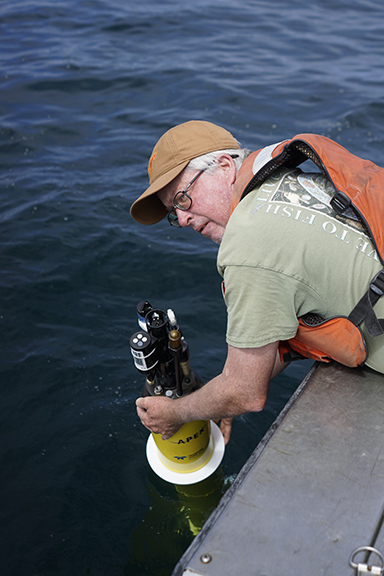
All life on Earth depends on a healthy ocean. Yet, it is surprising how little we know about the immense network of life in our seas. MBARI’s cutting-edge technology plays a vital role in advancing our understanding of the ocean, delivering a stream of surprising discoveries to inform ocean solutions. Partnering with our peers around the world brings MBARI’s advanced science and engineering to the global stage.
At MBARI, our “office” is Monterey Bay and its deep underwater canyon. Our advanced technology is revealing the stunning community of life that thrives deep beneath the ocean’s surface. Studying our blue backyard has revealed our connection to the ocean—how it sustains us and how our actions affect its future.
Monterey Bay is our window to the world’s ocean. We develop and design innovative new instruments locally, then make our technology and data available to scientific, resource management, and conservation partners around the world.
2025 saw the expansive global reach of MBARI science and technology, as teams across the institute conducted research from the Arctic to Antarctica and the Galapagos to Ghana. We are making important discoveries about the ocean-climate connection and revealing the processes that sculpt the seafloor.
Chemical sensors developed at MBARI have been instrumental in long-term monitoring of ocean pH through the Global Ocean Biogeochemistry Array initiative, and are already integral to emerging efforts to monitor the safety and effectiveness of ocean-based climate interventions.
MBARI is a leader in ocean exploration, science, and engineering. We are mobilizing our peers to fill critical gaps in our understanding of fundamental ocean processes.
In September, we welcomed a team from Ifremer, a French oceanographic research institute dedicated to protecting and restoring marine ecosystems, managing ocean resources sustainably, and sharing data about the ocean. Leaders from MBARI and Ifremer discussed how our organizations can help each other develop innovative new technology to study the ocean and make our work more widely accessible to peers, students, and the general public.

Leaders from MBARI and Ifremer discussed how our organizations can support each other in developing ocean-observing technologies and making our work more widely accessible. Image: Susan von Thun © 2025 MBARI
Working across sectors
The late Silicon Valley innovator and philanthropist David Packard believed that addressing the unique challenges of ocean exploration required a new type of research institute—one independent in spirit and collaborative by design. MBARI’s collaborations extend beyond the ocean exploration and science community.
Underwater imaging opens a unique window into the deep sea, but the ocean generates more data than humans can handle. Artificial intelligence (AI) and machine learning are transforming ocean science. MBARI is leading the marine research space in understanding how best to leverage AI to strengthen the bridge between human expertise and machine learning, support scientific discovery, and advance ocean exploration.
Led by MBARI Principal Engineer Kakani Katija, the FathomNet Program brings AI and ocean research together, connecting programmers, marine scientists, and ocean enthusiasts to accelerate ocean discovery.
Born from MBARI’s unparalleled deep-sea video archive—featuring thousands of expertly annotated images—and decades of AI research, FathomNet was created in collaboration with leaders in ocean exploration, computer science, and even video gaming.
To unlock the full potential of big ocean data, we need equally big advances in AI. In 2025, MBARI and FathomNet started a new partnership with Meta to leverage its state-of-the-art Segment Anything Model. Meta’s SAM 3 is capable of detecting, segmenting, and tracking virtually any object in images or video, even when prompted with just a click, a short text, or a visual example.

Annotated images from the FathomNet Database were used to train and evaluate Meta’s new SAM 3, expanding the variety of environments the model can recognize. Image courtesy of FathomNet
MBARI’s collaboration with Meta has the potential to benefit the entire marine science community. We need faster ways to understand our rapidly changing ocean. Combining MBARI’s unique ocean video archives, FathomNet’s deep ties to the ocean AI community, and Meta’s state-of-the-art AI models can accelerate discovery.
FathomNet invites anyone with a smartphone to contribute to ocean exploration and discovery.
FathomVerse is a mobile game developed through FathomNet that turns ocean exploration into play. Combining real scientific imagery with interactive gameplay, FathomVerse invites “FathomNauts” to classify real images of ocean life to help improve the AI that researchers use to study marine life and assess ocean health.

The FathomVerse team released a new version of the game in 2025 that added several features requested by FathomNauts to make the game more intuitive and engaging for everyone. Last year, FathomNauts played a total of 16,573 hours, resulting in 3,011,694 classification labels (teaching AI what’s in the image) and 1,025,803 localizations (teaching AI where the object is in the image).
The collective efforts of FathomVerse players around the world are enhancing the AI models that researchers rely on to deepen our understanding of marine ecosystems. Together, we can speed up breakthroughs in science and discover all life in the ocean.
Our collaborations around the world are providing vital information that resource managers, policymakers, and communities can use in their decision-making about the future of the ocean. MBARI’s work and our diverse partnerships are transforming ocean science and conservation, guiding a path that secures the future of the largest living space on Earth.
Research Publications:
Gilbert, J.A., R.S. Peixoto, A.H. Scholz, M.G. Dominguez Bello, L. Korsten, G. Berg, B. Singh, A. Boetius, F. Wang, C. Greening, K. Wrighton, S. Bordenstein, J.K. Jansson, J.T. Lennon, V. Souza, T. Thomas, D. Cowan, T.W. Crowther, N. Nguyen, L. Lucy Harper, L.P. Haraoui, S.L. Ishaq, and K. Redford. 2025. Launching the IUCN Microbial Conservation Specialist Group as a global safeguard for microbial biodiversity. Nature Microbiology, 10: 2359–2360. https://doi.org/10.1038/s41564-025-02113-5
Oestreich, W.K., M.F. Czapanskiy, K. Katija, N.R. Record, and M.S. Chapman. 2025. Collective science to inform global ocean protections. Ecology Letters, 28(8): e70168. https://doi.org/10.1111/ele.70168